Keep the signal. Keep its conditions.
A tone or vibration changed between two runs. Did the physical system change, the acquisition chain, or the analysis? Can another engineer find out from the record?
Observation / interpretation
A measurement is an observation. A suggested cause is a hypothesis. The record should preserve the distinction.
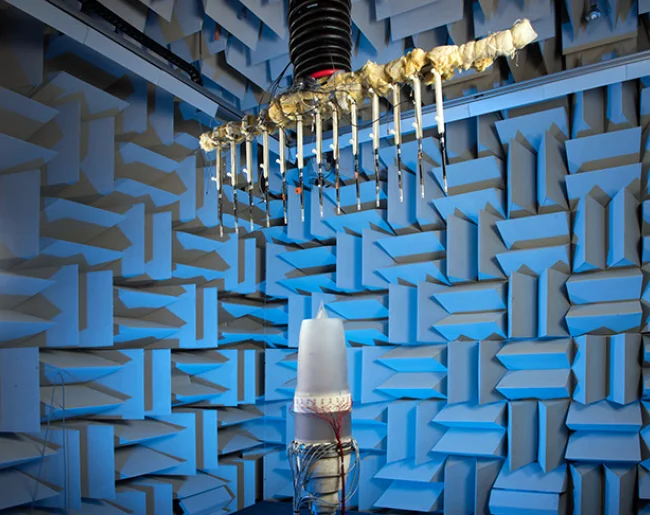
The sound alone is not the test.
A useful record binds channel and sensor identity to placement, calibration reference and operating conditions. Acquisition settings, environmental observations and input versions travel with the recording. That context lets a reviewer ask whether two analyses began with comparable observations.
Raw measurements, derived summaries and model outputs stay distinguishable and versioned. A correction should remain visible as a correction, not replace the original observation without a trace.
Follow the transformation.
Preserve processing parameters, the order of analysis and reviewer annotations. Modal investigation, tonal-event review, psychoacoustic comparison or candidate root-cause ranking could sit within a bounded scope. Each requires a defined method checked against an engineering reference.
When an earlier finding is retrieved, its conditions matter as much as its conclusion. Campaign memory should help an engineer see where a finding applies—and where it does not. Candidate causes remain hypotheses for engineering review, rather than diagnoses asserted by the system.
- Observe
- Recording, configuration and acquisition conditions.
- Transform
- Input versions, parameter sets and analysis sequence.
- Review
- Annotations, corrections and the basis for acceptance.
Explore the proposed workflow. Change the operating conditions or the analysis version and see how the retained context differs from an earlier run, and why that difference needs an engineer's review.
Change one condition. Reconstruct the analysis.
Begin with one recorded campaign and one bounded analysis task. Establish a baseline using the existing workflow. Introduce a controlled configuration change, preserve its transformation history and ask a second engineer to reconstruct the digital analysis from the written record.
Agree acceptance criteria before the scored run. Measure time to locate source conditions, record completeness, agreement with reviewed analysis and integration effort, alongside runtime and storage. An overhead figure is meaningful only against the same task without the evidence layer.
The proposed evidence package is an input manifest, processing configuration, comparison report, failed-run log and reviewer corrections. Remaining uncertainty belongs with the findings. Unexplained gaps or a budget outside agreed limits trigger a written decision to rescope or stop.
Digital reconstruction is not physical repeatability.
A reconstructed analysis can show how recorded data was processed. It cannot establish that a sensor was calibrated correctly, that a signal was authentic or that the physical experiment will repeat. Those require their own engineering evidence.
Perimeter handling and latency must be tested in the agreed environment. Autonomous or continuous monitoring needs a further evaluation; neither follows from preserving a single campaign record.
From the question to the test
Bring the change your team needs to explain.
Bring one bounded workload, your current workflow and the evidence you would need to make a decision.